Cosmopedia · Colonization Archive

Destiny Mission

The first large-scale interstellar colonization effort, carrying nearly seventy thousand settlers from the Sol System to Novaterra and inaugurating humanity's expansion beyond the stars.

Overview

The Destiny Mission was the first large-scale interstellar colonization project in human history and marked the beginning of humanity's expansion beyond the Sol System. While earlier expeditions had established small research outposts and experimental settlements around nearby stars, the Destiny Mission represented the first attempt to transport an entire self-sustaining population across interstellar space.

Organized during the early Colonial Era, the mission targeted the habitable world of Novaterra in the Delta Pavonis system. Nearly seventy thousand colonists were selected from across the Sol System and placed into long-duration hibernation aboard three massive colony vessels. Accompanied by a smaller advance ship carrying engineers, scientists, and construction specialists, the expedition sought to establish humanity's first true extrasolar civilization.

The success of the Destiny Mission demonstrated that permanent interstellar settlement was not only possible, but practical. In the centuries that followed, its achievements inspired hundreds of similar expeditions, ultimately leading to the formation of the vast network of human worlds that now spans known space.
Origins

The Destiny Mission emerged from centuries of technological progress that began with the construction of New Atlantis and the Atlantic Space Elevator on Earth. The elevator dramatically reduced the cost of reaching orbit and enabled the orbital industry necessary to build colony vessels on a scale never before attempted.

As humanity spread throughout the Solar System, settlement efforts expanded from Luna and Mars to the Jovian moons, orbital habitats, asteroid colonies, and deep-space industrial zones. Population growth, resource demand, and the desire for new beginnings pushed human civilization toward the next frontier: permanent settlement around other stars.

By the time plans for the Destiny Mission were approved, advances in faster-than-light navigation, cryogenic hibernation, autonomous construction systems, and long-duration ecological support had matured enough to support a major interstellar expedition. Delta Pavonis was selected after surveys identified Novaterra as one of the most Earth-like worlds within reach of contemporary interstellar drives.

Historians often regard the Destiny Mission as the moment humanity ceased being a Solar System civilization and became an interstellar civilization.

For many citizens of the recovering homeworld and the young colonies of Sol, the mission represented a chance to begin again on a distant, untouched world.

The Expedition

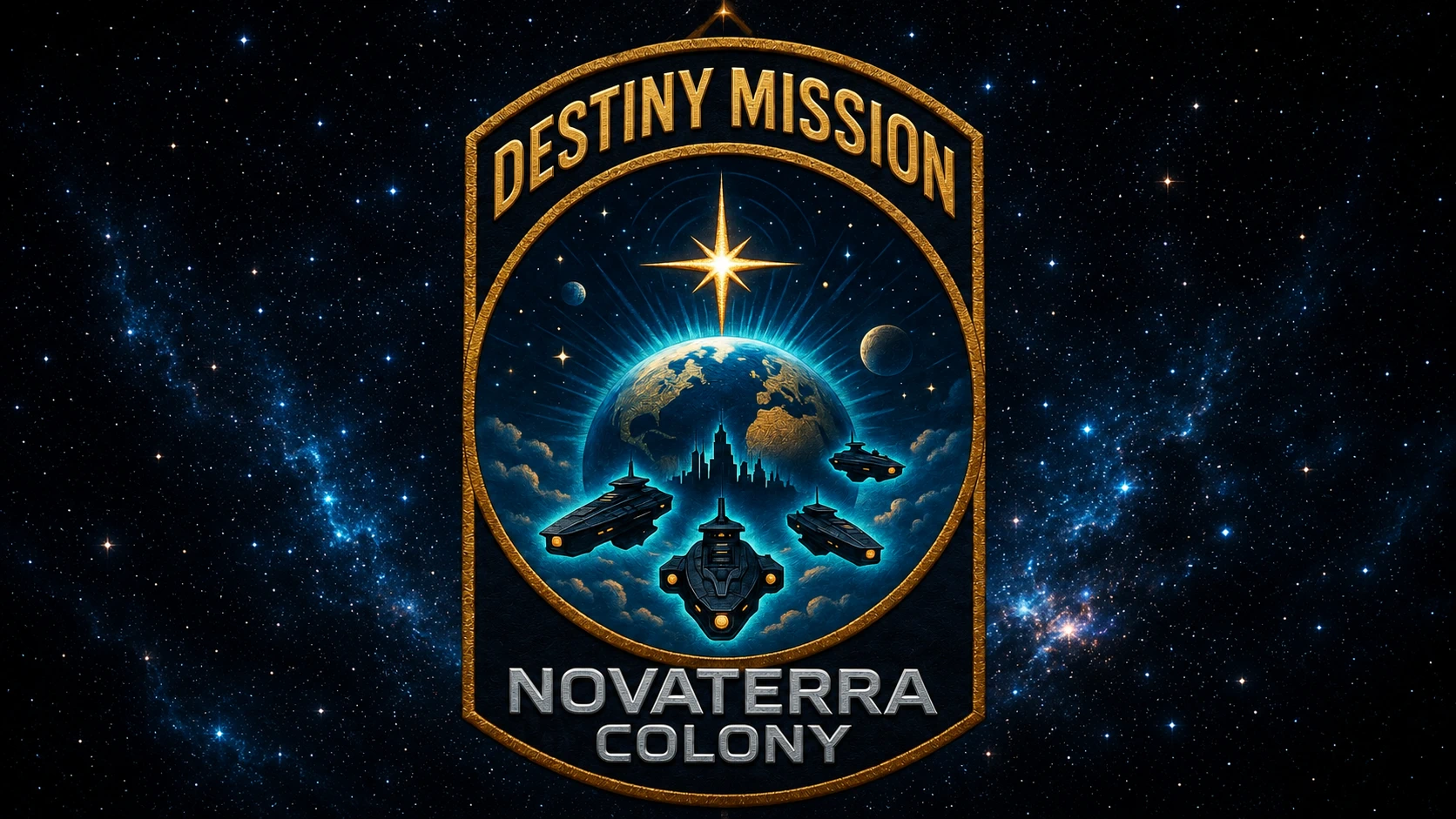
The expedition consisted of four vessels. Three enormous colony ships transported nearly seventy thousand settlers, along with equipment, agricultural stock, prefabricated structures, and industrial machinery required to establish a permanent settlement. A fourth vessel, smaller and faster than the colony transports, served as the advance scout ship.

Mission planners designed the expedition so the scout vessel would arrive first and prepare the colony site before the larger ships completed the journey. Its crew of approximately two hundred engineers, scientists, medical personnel, surveyors, and construction specialists was tasked with establishing the foundation of the first human city on Novaterra.

The advance party selected a settlement site for New Hope and began preparing livable structures, power systems, landing zones, water infrastructure, and surrounding farmland. Genetically engineered crops designed for Novaterra's environment were planted around the future city to help support the incoming population.

The scout crew faced immediate setbacks. Severe storms, flooding, and unstable terrain forced the team to abandon the original site and relocate portions of the settlement. Months of work were lost, and the new city remained only partially complete as the main colony vessels approached the system.

Arrival at Novaterra

When the colony ships reached Delta Pavonis, the settlers awoke from hibernation to find a world that was beautiful, promising, and only partially prepared for them. New Hope was functional, but unfinished. Housing was limited, agricultural zones were still being stabilized, and many essential systems were operating under emergency conditions.

Despite the difficult start, the arrival of the colonists marked one of the defining moments of human history. For the first time, a large human population permanently settled a planet orbiting another star. New Hope expanded rapidly from a frontier construction camp into a true city, eventually becoming the political, economic, and cultural center of Novaterra.

The colony's survival exceeded the expectations of its most cautious planners. Within a few generations, Novaterra had become one of the most successful worlds beyond Sol and a staging point for further exploration throughout nearby regions of space.

Legacy

The Destiny Mission became the template for nearly every major colonization effort that followed. Its advance-scout strategy, settlement procedures, hibernation protocols, orbital assembly methods, and large-population transport model were adapted for missions bound to dozens of newly discovered worlds.

Many of the most influential worlds in modern human civilization trace their origins to programs modeled directly after Destiny. The mission transformed interstellar colonization from a risky experiment into a practical and repeatable process.

Today, monuments dedicated to the expedition can be found across countless systems. New Hope remains one of humanity's oldest extrasolar cities, while the Destiny Mission itself is remembered as the voyage that opened the stars to permanent human settlement.