Lore Archive · Native Species

Ravakor

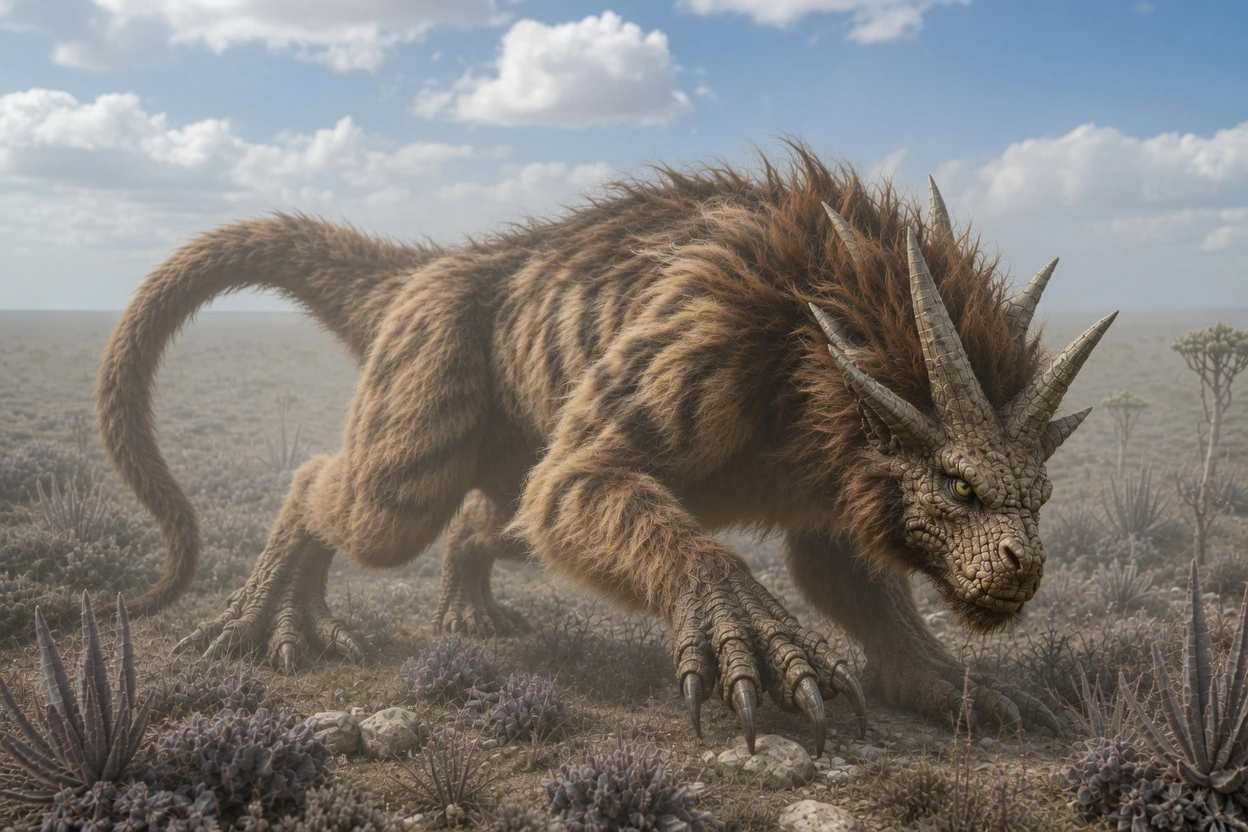
A powerful northern predator native to Dubheasa Prime, known for its striped insulating fur, armored facial plates, forward horns, and heavy claws built for rocky scrublands and cold plains.

Native SpeciesDubheasa PrimeApex PredatorNorthern LatitudesLore Index

Overview

MegafaunaSolitary HunterCold PlainsDubheasan Wildlife

The Ravakor is one of the most recognizable animals of Dubheasa Prime. Common across much of the planet's northern latitudes, it occupies cold plains, rocky basins, gray-purple scrublands, and open highland valleys where its strength and endurance make it one of the dominant land predators.

At a glance, the species appears almost mammalian, with a long muscular body, thick striped fur, and a heavy tail used for balance during sudden lunges. Its head, however, is protected by reptilian facial plates and a crown of forward-facing horns that make the animal unmistakable even at a distance.

Ravakors are solitary and territorial. They usually avoid heavily settled areas, but remote communities treat them with caution and respect. On Dubheasa Prime, the animal has become a symbol of northern wilderness: dangerous, resilient, and inseparable from the planet's colder frontier landscapes.
Anatomy and Adaptations

Insulating Fur

Dense tawny fur allows the Ravakor to remain active through freezing winds and long northern winters. Natural striping breaks up its outline in scrubland and rocky terrain.

Armored Face

Thick facial plates protect the head during territorial clashes, prey struggles, and impacts with stone or frozen ground while pursuing quarry.

Forward Horns

The crown of horns is used for intimidation, close combat, and defense against rival predators. Older Ravakors often show chipped or scarred horn surfaces.

Heavy Claws

Oversized claws provide traction on loose stone and ice, tear into armored prey, and allow the animal to dig shallow dens or uncover burrowing animals.

Ecology and Hunting

Northern Range

Ravakors thrive in the colder belts of Dubheasa Prime, especially where open plains meet rocky ridges and scattered alien scrub. These environments provide cover, visibility, and enough prey density to sustain large territorial hunters.

The animal favors ambush and short explosive charges rather than long pursuit. It stalks through low vegetation, freezes when spotted, and closes distance rapidly with powerful forelimbs. Its tail stabilizes the body during sudden turns, while the claws grip soil, stone, and frost-packed ground.

Although capable of killing large prey, Ravakors are opportunists. They scavenge when necessary, defend kills aggressively, and may follow migrating herbivores across seasonal routes. Juveniles remain near protected scrub or rocky shelters until large enough to compete for open territory.

Ravakor moving across Dubheasa Prime scrubland
Northern RavakorA mature Ravakor crossing scrubland in the colder latitudes of Dubheasa Prime.

Relationship with Humans

Early settlers on Dubheasa Prime regarded the Ravakor as one of the strongest signs that the northern continents could not be treated as empty frontier. Mining teams, survey expeditions, and remote agricultural settlements quickly learned to map denning zones and seasonal migration corridors.

Modern environmental policy protects the species across most of its natural range. Ravakors are monitored through aerial surveys, passive sensor stations, and wildlife corridors designed to keep them away from transportation routes and expanding towns. Relocation is rare and used only when an animal becomes trapped near dense settlements.

In northern cities such as Shardika and Nanuk, the Ravakor appears in public art, sports insignia, survival schools, and regional folklore. It represents endurance, territorial independence, and the unforgiving beauty of Dubheasa Prime's high-latitude wilderness.

Archive note: Ravakors are dangerous wild animals. Settlements in their range maintain exclusion zones, prey monitoring networks, and emergency response teams during seasonal movement periods.